Seasonal color as the organizing principle. Designed so something is peaking at every point from April through October -- not just during one showstopping week.
Color Infusion installations are built around a curated sequence of bloom times. The goal is never a single dramatic moment -- it's a yard that looks intentional and alive every time you pull into the driveway, whether it's May or September.
The plants we use in this style are specifically selected for Zone 4b performance. No English lavender, no butterfly bush, no crape myrtle. The color palette is built from plants that actually survive a Minnesota winter and return better each year.
This style pairs well with traditional, craftsman, colonial, and farmhouse homes where a rich, layered front garden fits the character of the architecture.
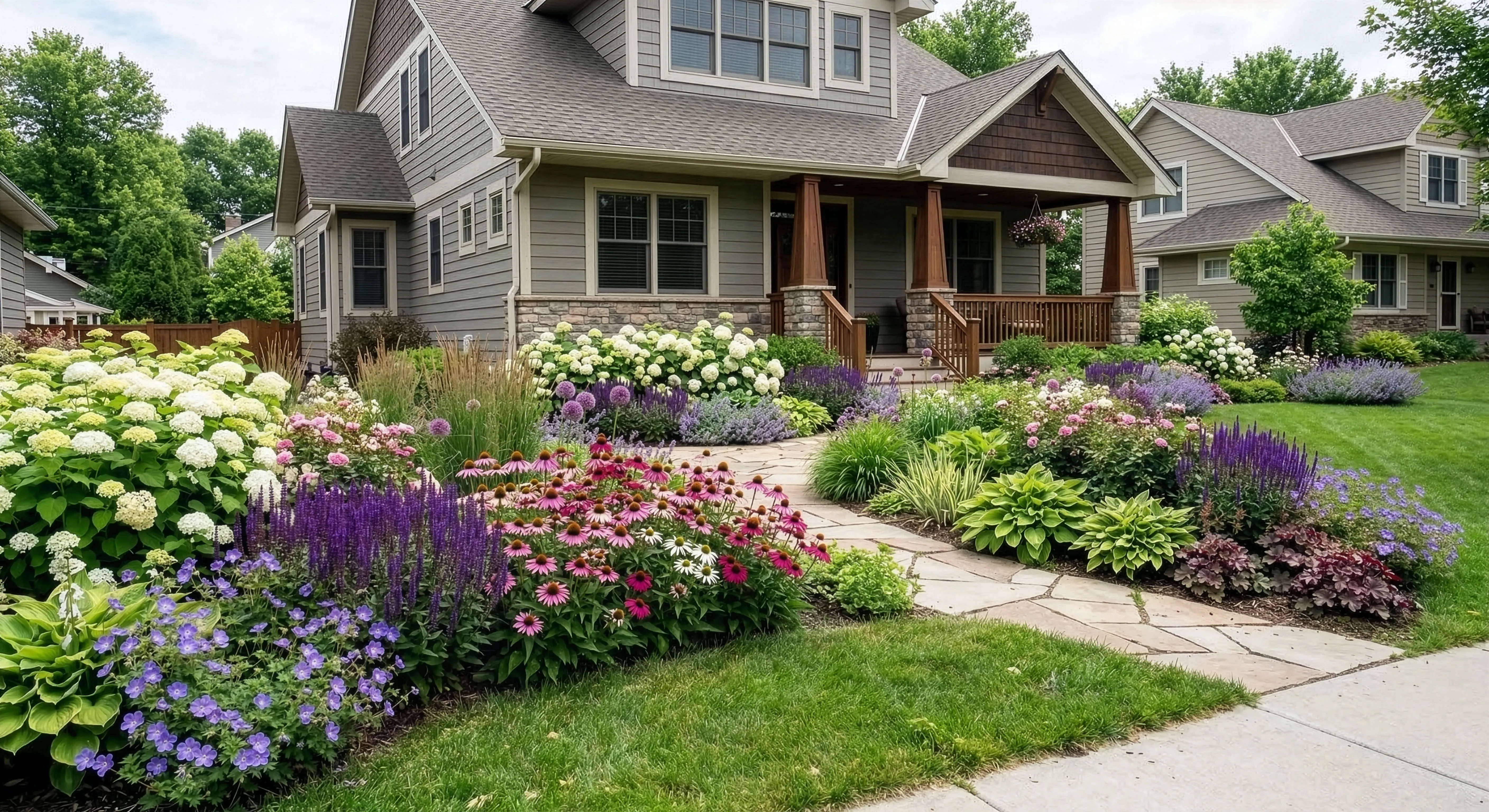
White hydrangeas anchor the back of both beds, coneflowers carry the middle in pink and magenta, deep purple salvia rises above the bed line, and blue hardy geraniums soften the front border. Four distinct colors in one simultaneous composition -- sequenced by tone so they read as a palette rather than as competing plants.
Multi-color plantings this rich are harder to design than they look. The wrong pairing at any layer turns chaotic fast. The trick is sequencing by color temperature -- warm tones at the center, cool tones at the edges -- so the bed reads as a single palette rather than competing plants. When that layering is right, the interest holds well into late summer.
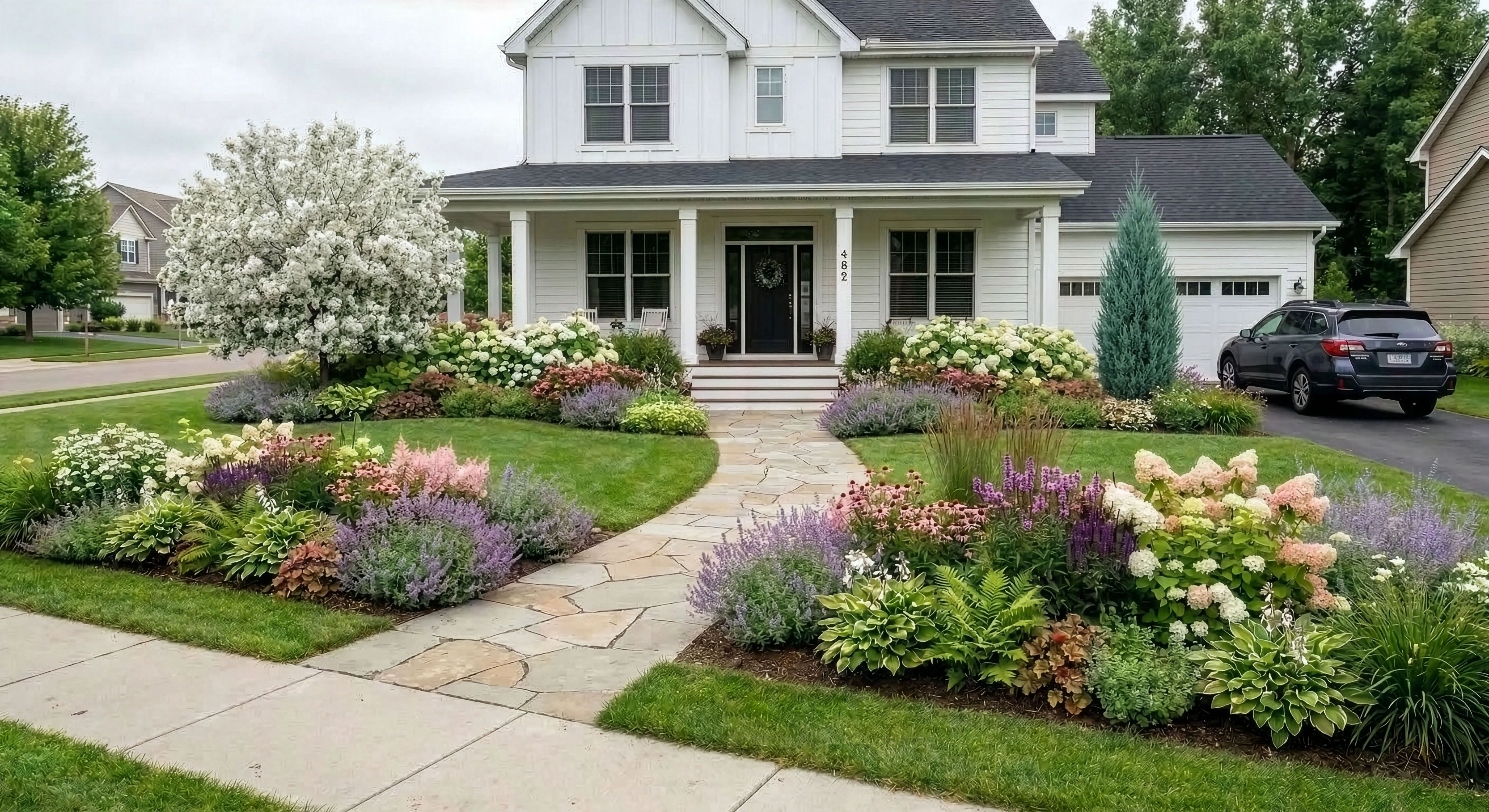
A white farmhouse entry framed by mirror-image beds built in a deliberately restrained palette: lavender catmint at the front edge, blush astilbe rising in feathery midsummer plumes, white hydrangeas along the foundation, and chartreuse hosta filling the base layer. A white-blooming crabapple anchors the left bed corner.
The symmetrical layout reinforces the centered entry axis of the home. Both beds peak together in midsummer so they read from the street as a single unified frame rather than two separate plantings. Holding the entire palette to cool and neutral tones -- no warm yellows or saturated reds -- keeps the mood consistent from curb to front door.
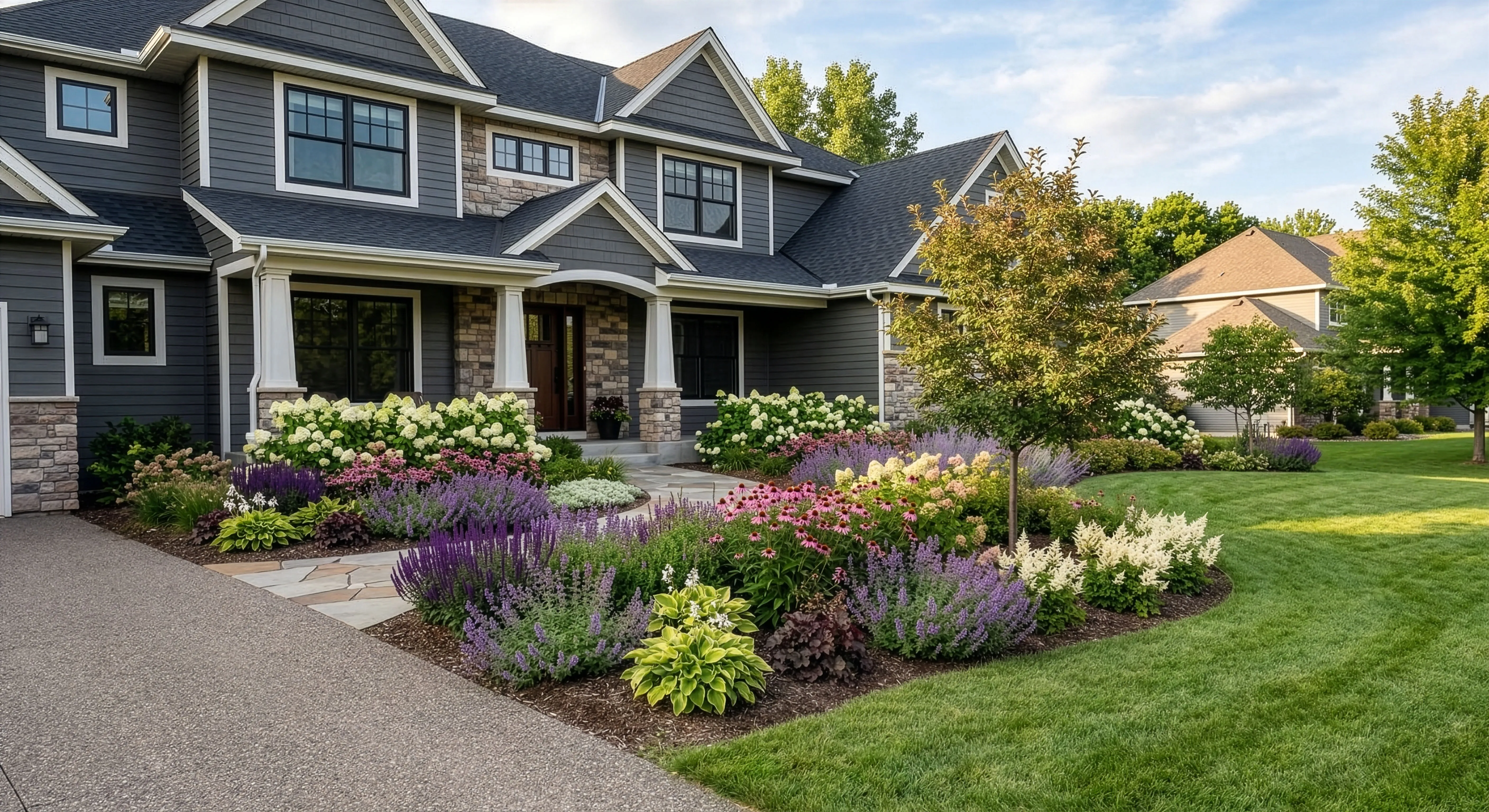
Beds that span the full facade of a large dark-sided craftsman, organized around generous drifts of deep purple salvia against the near-charcoal exterior. White hydrangeas along the foundation provide the brightness that keeps the composition from going too dark; pink echinacea fills the middle ground between them.
The dark siding was treated as a design asset rather than a neutral backdrop. Purple reads especially vivid against dark exteriors -- the contrast is more intense than the same planting would achieve against a cream or gray house. Scale was equally important: these beds span the full width of a large home, with drifts large enough to read clearly from the street.
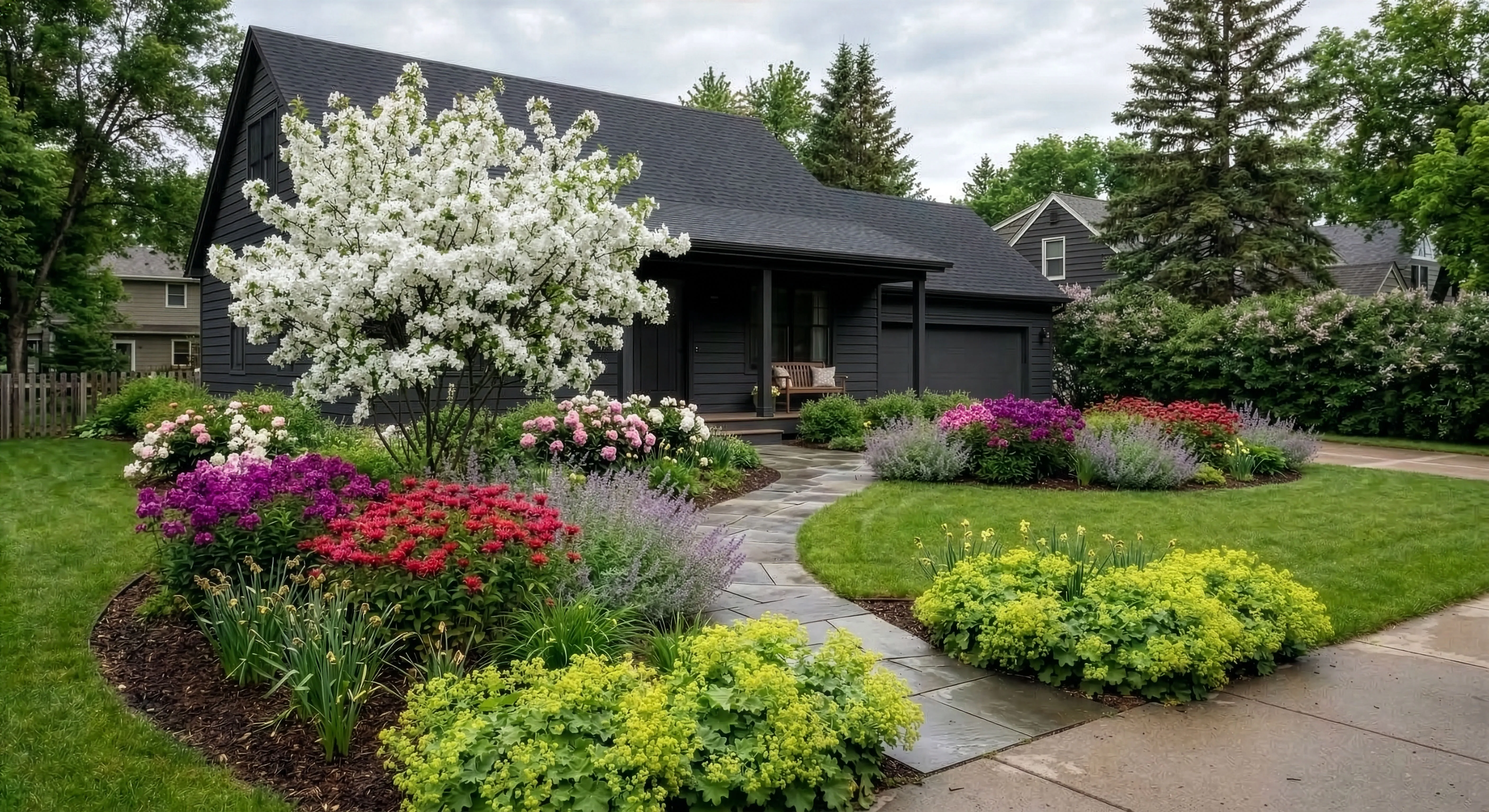
A near-black exterior as the backdrop for island beds built on maximum contrast. A white-blooming crabapple rises against the dark siding at the back of the composition; the island beds in the foreground are filled with vivid spring color -- deep magenta, crimson, and chartreuse -- that reads almost luminous against the dark house.
The dark exterior was the starting point, not an afterthought. A house this dark is a foil, and the planting was built to use it. Spring is when the yard earns its moment -- the white crabapple blooms for two weeks in May with an intensity that no summer plant can match against that backdrop.
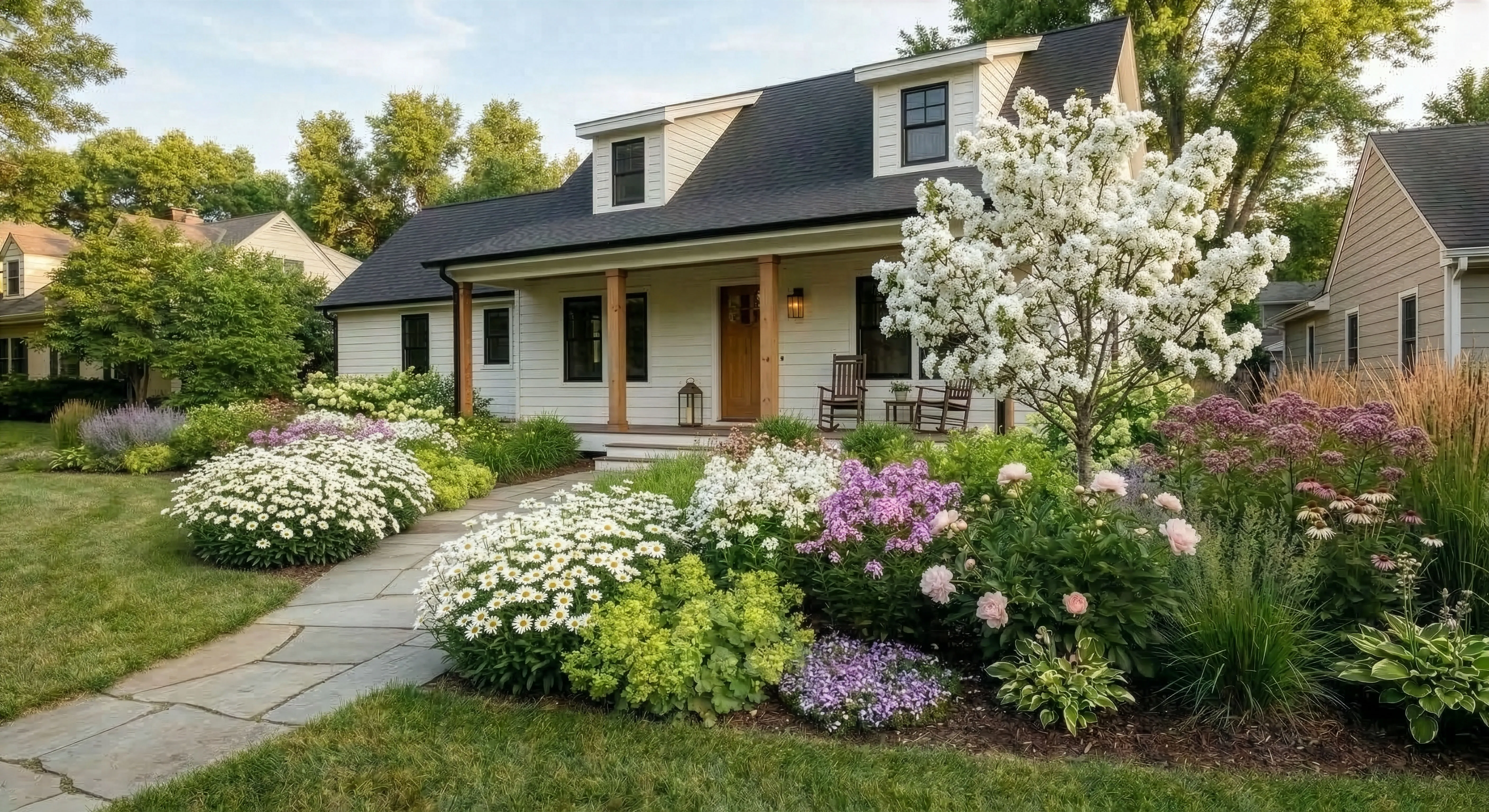
A cream bungalow with a covered front porch, surrounded by a loose, layered planting in soft whites and pinks. White daisies drift through the right beds in informal masses; white hydrangeas anchor the left corner; a white-blooming tree bridges the vertical gap between the low perennials and the roofline. Lavender and pink perennials fill the middle ground.
A front yard with a covered porch has two audiences: people approaching from the street, and the homeowner sitting outside. At street distance, the masses of white read clean and polished. Up close, in the chairs, the texture and variation of individual flowers takes over. Both experiences were considered in how the beds were layered.
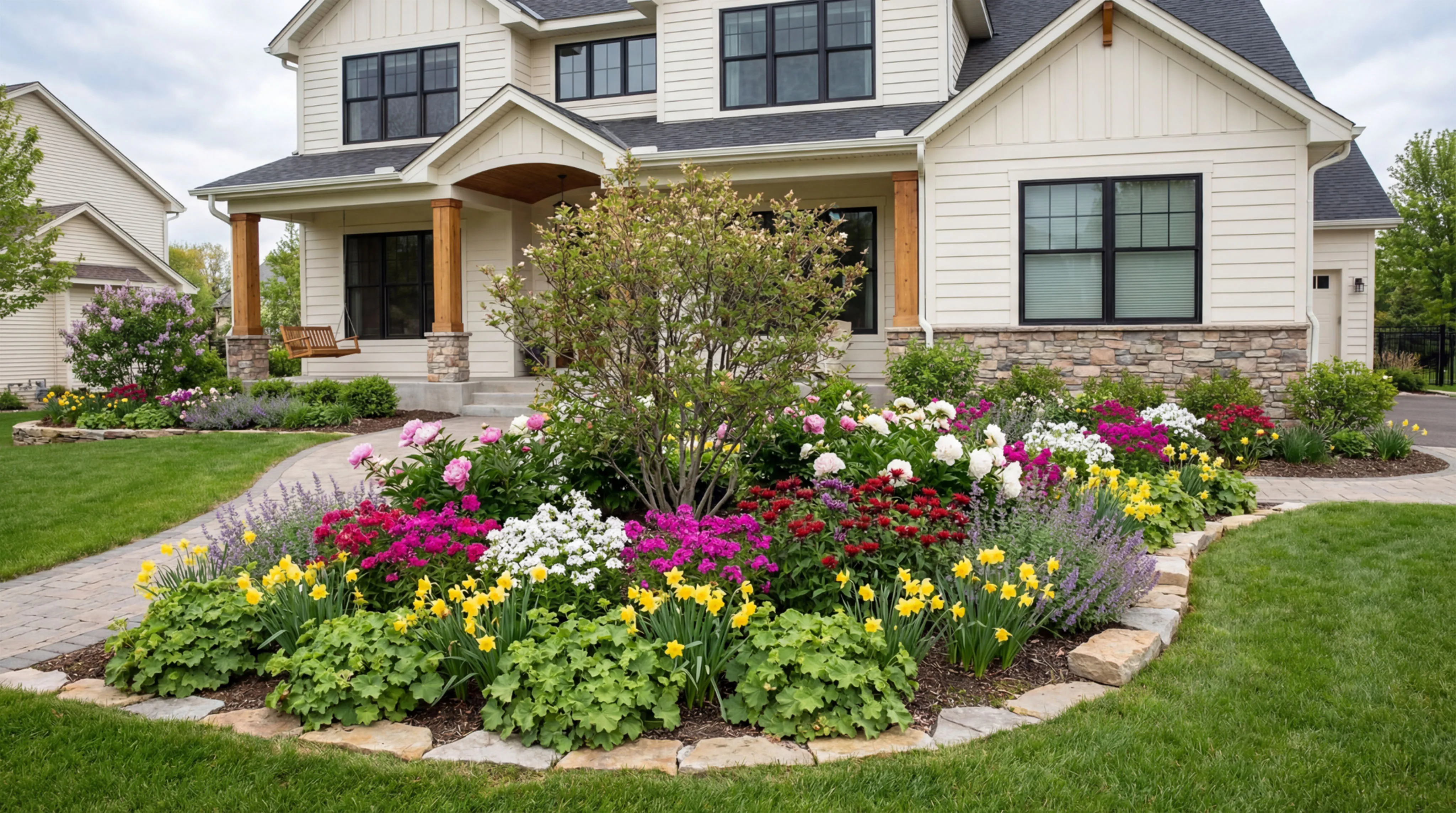
A central island bed rather than a foundation planting -- the organizing principle of this front yard. A multi-stem flowering shrub anchors the center of the composition; spring bulbs ring the outer edge in yellow and deep magenta; lavender perennials fill the back arc. The open lawn surrounding the bed on all sides is part of the design.
Island beds in open lawns have to earn their placement -- too small and they look like an afterthought; too large and the lawn fragments into leftover strips. Getting the scale right is where most island beds go wrong. Here the bed is generous enough to feel intentional from the street without swallowing the lawn. The spring bulbs return each year; the shrub fills out further with each growing season.
Get a free quote. We walk the property, show you exactly what we'd build, and have a fixed-price proposal in your hands within 24 hours.
Get a Free Quote